You may also like to read:

You may also enjoy reading about the family stories in my novels and short stories at The Homeplace Series blog. You can sign up for e-mail reminders.

Monday, December 28, 2020

It's Monday, What are you Reading? George Washington, Entrepreneur


It's Monday, What are you Reading? 

George Washington, Entrepreneur: 

How Our Founding Father’s Private Business Pursuits Changed America and the World

By John Berlau


https://www.amazon.com/George-Washington-Entrepreneur-Founding-Business/dp/1250172608/


The first of three more Christmas books. I’m always interested in new approaches to these bios of the Presidents and Founding Fathers. I’m now especially interested to see how this one compares to others I have read. Usually learn new tidbits, from the different slants the authors use. 


Amazon’s Description:


A business biography of George Washington, focusing on his many innovations and inventions.


George Washington: general, statesman...businessman? Most people don't know that Washington was one of the country's first true entrepreneurs, responsible for innovations in several industries. In George Washington, Entrepreneur, John Berlau presents a fresh, surprising take on our forefather's business pursuits.


History has depicted Washington as a gifted general and political pragmatist, not an intellectual heavyweight. But he was a patron of inventors and inveterate tinkerer, and just as intelligent as Jefferson or Franklin. His library was filled with books on agriculture, history, and philosophy. He was the first to breed horses with donkeys to produce the American mule. On his estate, he grew countless varieties of trees and built a greenhouse full of exotic fruits, herbs, and plants. Unlike his Virginia neighbors who remained wedded to tobacco, Washington planted seven types of wheat. His state-of-the-art mill produced flour which he exported to Europe in sacks stamped "G. Washington"―one of the very first branded food products. Mount Vernon was also home to a distillery and became one of the largest American whiskey producers of the era.


Berlau's portrait of Washington, drawn in large part from his journals and extensive correspondence, presents a side of him we haven't seen before. It is sure to delight readers of presidential biography and business history.


Monday, December 14, 2020

It’s Monday, What are you Reading? Franklin & Washington


It’s Monday, What are you Reading? Franklin & Washington

The Founding Partnership by Edward J. Larson


https://www.amazon.com/Franklin-Washington-Partnership-Edward-Larson-ebook/dp/B07RNL7LY5/


Got a Kindle recommendation I could no refuse. Not sure why I had missed this one earlier, but it definitely fits my reading preferences. Thanks, Amazon, you did it again… even tho’ it only cost me $1.02 with credits… Good start to it…

Amazon Description:

"Larson's elegantly written dual biography reveals that the partnership of Franklin and Washington was indispensable to the success of the Revolution." —Gordon S. Wood 

 
From the Pulitzer Prize-winning historian comes a masterful, first-of-its-kind dual biography of Benjamin Franklin and George Washington, illuminating their partnership's enduring importance. 


NATIONAL BESTSELLER • One of Washington Post's "10 Books to Read in February" • One of USA Today’s “Must-Read Books" of Winter 2020  •  One of Publishers Weekly's "Top Ten" Spring 2020 Memoirs/Biographies


Theirs was a three-decade-long bond that, more than any other pairing, would forge the United States. Vastly different men, Benjamin Franklin—an abolitionist freethinker from the urban north—and George Washington—a slavehold­ing general from the agrarian south—were the indispensable authors of American independence and the two key partners in the attempt to craft a more perfect union at the Constitutional Convention, held in Franklin’s Philadelphia and presided over by Washington. And yet their teamwork has been little remarked upon in the centuries since.
Illuminating Franklin and Washington’s relationship with striking new detail and energy, Pulitzer Prize–winning historian Edward J. Larson shows that theirs was truly an intimate working friendship that amplified the talents of each for collective advancement of the American project.
During the French and Indian War, Franklin supplied the wagons for General Edward Braddock’s ill-fated assault on Fort Duquesne, and Washington buried the general’s body under the dirt road traveled by those retreating wagons. After long sup­porting British rule, both became key early proponents of inde­pendence. Rekindled during the Second Continental Congress in 1775, their friendship gained historical significance during the American Revolution, when Franklin led America’s diplomatic mission in Europe (securing money and an alliance with France) and Washington commanded the Continental Army. Victory required both of these efforts to succeed, and success, in turn, required their mutual coordination and cooperation. In the 1780s, the two sought to strengthen the union, leading to the framing and ratification of the Constitution, the founding document that bears their stamp.
Franklin and Washington—the two most revered figures in the early republic—staked their lives and fortunes on the American experiment in liberty and were committed to its preservation. Today the United States is the world’s great super­power, and yet we also wrestle with the government Franklin and Washington created more than two centuries ago—the power of the executive branch, the principle of checks and balances, the electoral college—as well as the wounds of their compromise over slavery. Now, as the founding institutions appear under new stress, it is time to understand their origins through the fresh lens of Larson’s Franklin & Washington, a major addition to the literature of the founding era.


Monday, December 7, 2020

It’s Monday, What are you Reading? Ten Lessons


It’s Monday, What are you Reading? 

Ten Lessons for a Post-Pandemic World 

by

Fareed Zakaria


https://www.amazon.com/Lessons-Post-Pandemic-World-Fareed-Zakaria-ebook/dp/B08BWRX6H5/


I saw Rachel Maddow on MSNBC interview Fareed Zakaria of CNN about this new book, and knew I had to have it, for reference, at least… got the Kindle edition. Their discussion on “Good Government” in Lesson Two seemed especially relevant. Can’t wait to check it out. It is on my Kindle right now. Should go read some more!

Amazon Description:

COVID-19 is speeding up history, but how? What is the shape of the world to come?


Lenin once said, "There are decades when nothing happens and weeks when decades happen." This is one of those times when history has sped up. CNN host and best-selling author Fareed Zakaria helps readers to understand the nature of a post-pandemic world: the political, social, technological, and economic consequences that may take years to unfold. Written in the form of ten "lessons," covering topics from natural and biological risks to the rise of "digital life" to an emerging bipolar world order, Zakaria helps readers to begin thinking beyond the immediate effects of COVID-19. Ten Lessons for a Post-Pandemic World speaks to past, present, and future, and, while urgent and timely, is sure to become an enduring reflection on life in the early twenty-first century.


Monday, September 7, 2020

It’s Monday, What are you Reading? A History of the Ozarks, Vol 2


It’s Monday, What are you Reading? 
A History of the Ozarks, Vol 2
The Conflicted Ozarks
by Brooks Blevins

I’ve had this book nearly a year, it appears…a busy year, not much reading, really. It was two years ago this week that I wrote about Volume 1. Sept is important for this series, it seems.

Description at Amazon:

The Ozarks of the mid-1800s was a land of divisions. The uplands and its people inhabited a geographic and cultural borderland straddling Midwest and west, North and South, frontier and civilization, and secessionist and Unionist. As civil war raged across the region, neighbor turned against neighbor, unleashing a generation of animus and violence that lasted long after 1865. The second volume of Brooks Blevins's history begins with the region's distinctive relationship to slavery. Largely unsuitable for plantation farming, the Ozarks used enslaved persons on a smaller scale or, in some places, not at all. Blevins moves on to the devastating Civil War years where the dehumanizing, personal nature of Ozark conflict was made uglier by the predations of marching armies and criminal gangs. 

Blending personal stories with a wide narrative scope, he examines how civilians and soldiers alike experienced the war, from brutal partisan warfare to ill-advised refugee policies to women's struggles to safeguard farms and stay alive in an atmosphere of constant danger. The war stunted the region's growth, delaying the development of Ozarks society and the processes of physical, economic, and social reconstruction. More and more, striving uplanders dedicated to modernization fought an image of the Ozarks as a land of mountaineers and hillbillies hostile to the idea of progress. Yet the dawn of the twentieth century saw the uplands emerge as an increasingly uniform culture forged, for better and worse, in the tumult of a conflicted era. 

The Ozarks of the mid-1800s was a land of divisions. The uplands and its people inhabited a geographic and cultural borderland straddling Midwest and west, North and South, frontier and civilization, and secessionist and Unionist. As civil war raged across the region, neighbor turned against neighbor, unleashing a generation of animus and violence that lasted long after 1865. The second volume of Brooks Blevins's history begins with the region's distinctive relationship to slavery. Largely unsuitable for plantation farming, the Ozarks used enslaved persons on a smaller scale or, in some places, not at all. Blevins moves on to the devastating Civil War years where the dehumanizing, personal nature of Ozark conflict was made uglier by the predations of marching armies and criminal gangs. 

Blending personal stories with a wide narrative scope, he examines how civilians and soldiers alike experienced the war, from brutal partisan warfare to ill-advised refugee policies to women's struggles to safeguard farms and stay alive in an atmosphere of constant danger. The war stunted the region's growth, delaying the development of Ozarks society and the processes of physical, economic, and social reconstruction. More and more, striving uplanders dedicated to modernization fought an image of the Ozarks as a land of mountaineers and hillbillies hostile to the idea of progress. Yet the dawn of the twentieth century saw the uplands emerge as an increasingly uniform culture forged, for better and worse, in the tumult of a conflicted era.


Monday, August 10, 2020

It’s Monday, What are you Reading? You’re Fired


It’s Monday, What are you Reading? 

You’re Fired:

The Perfect Guide to Beating Donald Trump by Paul Begala


https://www.amazon.com/Youre-Fired-Perfect-Beating-Donald/dp/1982160047/


I’ve been a Paul Begala fan since 1992… political operative insight is something I seek out, since working for Gov. Ray in Iowa in the 1970s… could not pass this one up. Enjoy! I will! ;-)

Amazon Description:


“You’re fired!” Donald Trump became famous bellowing those words in a make-believe boardroom. In November, tens of millions of Americans want to yell it right back at him. Yet Trump has seemed to almost defy the laws of political physics. Paul Begala, one of America’s greatest political talents, lays out the strategy that will defeat him and send him and his industrial-strength spray-on tan machine back to Mar-a-Lago.

In You’re Fired, Paul Begala tells us how Trump uses division to distract from the actual reality of his record. Distraction, he argues, is Trump’s superpower. And this book is Kryptonite. In it, the man who helped elect Bill Clinton and reelect Barack Obama, details:

-The special weapons and tactics needed in the unconventional war against this most unconventional politician
-How to drive a wedge—or, rather, a pickup truck—between Trump and many of his supporters, especially blue-collar workers and farmers
-Where the votes to defeat Trump will come from, and how the Rising American Electorate can catch Trump flat-footed
-How Democrats can run on issues ranging from Coronavirus and healthcare to the economy, as well as climate change and Trump’s long-term plan to dominate the federal judiciary
-There is one chapter called simply, “This Chapter Will Beat Trump.” Find out why Begala is so confident and what issue he says will sink the Trumptanic

Full of memorable advice and Begala’s trademark wit, You’re Fired focuses on the lessons we can learn from the party’s successes and failures—and the crucial tools Democrats need to beat Trump. 


Monday, June 22, 2020

It’s Monday, What are you Reading? Exercise of Power


It’s Monday, What are you Reading?

Exercise of Power: American Failures, Successes,

and a New Path Forward in the Post-Cold War World

by Robert M. Gates


This looks like it would go well with Team of Five… history over several presidential terms from a different perspective. He had both governmental and academe experience to contribute.

From Amazon Description:
From the former secretary of defense and author of the acclaimed #1 best-selling memoir, Duty, a candid, sweeping examination of power in all its manifestations, and how it has been exercised, for good and bad, by American presidents in the post-Cold War world.

Since the end of the Cold War, the global perception of the United States has progressively morphed from dominant international leader to disorganized entity, seemingly unwilling to accept the mantle of leadership or unable to govern itself effectively. Robert Gates argues that this transformation is the result of the failure of political leaders to understand the complexity of American power, its expansiveness, and its limitations. He makes clear that the successful exercise of power is not limited to the use of military might or the ability to coerce or demand submission, but must encompass as well diplomacy, economics, strategic communications, development assistance, intelligence, technology, ideology, and cyber. By analyzing specific challenges faced by the American government in the post-Cold War period--Iran, Iraq, Afghanistan, North Korea, Syria, Libya, Russia, China, and others--Gates deconstructs the ways in which leaders have used the instruments of power available to them. With forthright judgments of the performance of past presidents and their senior-most advisers, firsthand knowledge, and insider stories, Gates argues that U.S. national security in the future will require learning, and abiding by, the lessons of the past, and re-creating those capabilities that the misuse of power has cost the nation.


Monday, May 25, 2020

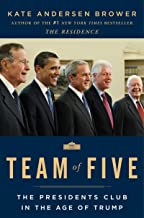
It’s Monday, What are you Reading? Team of Five


It’s Monday, What are you Reading? Team of Five:
The President’s Club in the Age of Trump 
by Kate Andersen Brower


When I became aware of this book about the President’s Club, I knew I had to have it and read it. A favorite subject, for sure. Not disappointed.

Description from Amazon:
 
From the #1 New York Times bestselling author of The Residence and First Women—also a New York Times bestseller—comes a poignant, news-making look at the lives of the five former presidents in the wake of their White House years, including the surprising friendships they have formed through shared perspective and empathy.

 
After serving the highest office of American government, five men—Jimmy Carter, the late George H. W. Bush, Bill Clinton, George W. Bush, and Barack Obama—became members of the world’s most exclusive fraternity. In Team of Five, Kate Andersen Brower goes beyond the White House to uncover what, exactly, comes after the presidency, offering a glimpse into the complex relationships of these five former presidents, and how each of these men views his place in a nation that has been upended by the Oval Office’s current, norm-breaking occupant, President Donald Trump.
With an empathetic yet critical eye and firsthand testimony from the Carters, Donald Trump, and the top aides, friends, and family members of the five former presidents, Team of Five takes us inside the exclusive world of these powerful men and their families, including the unlikely friendship between George W. Bush and Michelle Obama, the last private visits Bill Clinton and Barack Obama shared with George H.W. Bush, and the Obamas’ flight to Palm Springs after Donald Trump’s inauguration. Perhaps most timely, this insightful, illuminating book overflows with anecdotes about how the ex-presidents are working to combat President Trump’s attempts to undo the achievements and hard work accomplished during their own terms.
Perhaps most poignantly, Team of Five sheds light on the inherent loneliness and inevitable feelings of powerlessness and frustration that come with no longer being the most important person in the world, but a leader with only symbolic power. There are ways, though, that these men, and their wives, have become powerful political and cultural forces in American life, even as so-called “formers.”
Team of Five includes 16 pages of color photographs.